
How often should automatic doors be serviced?
Next Doors Ltd · 6 min read · Building managers & owners · Updated September 2026

New to automatic door compliance? Read our guide first: What is BS EN 16005 and is my automatic door compliant?
The short answer: at least once a year for most commercial buildings, and twice a year for high-traffic sites such as retail, healthcare, hospitality, and education. That is the minimum the law expects. But the more useful question is what a service actually involves — because many building owners are paying for visits that tick a box but miss the checks that matter. This guide explains exactly what a proper service covers, how often you genuinely need one, and why planned maintenance costs a fraction of reactive repair.
Already know you need a service? Next Doors carries out BS EN 16005-aligned servicing for commercial properties across the UK. Documented, certified, and completed in a single visit.
Is servicing automatic doors a legal requirement in the UK?
Yes — though not in the way most people expect. There is no single law that states “automatic doors must be serviced every X months.” What UK law does instead is impose a duty: keep the door safe, keep it working, and be able to prove you did.
Three pieces of legislation sit behind that duty. The Provision and Use of Work Equipment Regulations 1998 (PUWER) require that all work equipment — including powered pedestrian doors — is maintained in efficient working order and good repair. The Workplace (Health, Safety and Welfare) Regulations 1992 require that doors and gates are suitably constructed and maintained. The Health and Safety at Work Act 1974 sits over both as a general duty of care to anyone who uses or passes through your building.
None of those name a specific interval. What they do assume is that you have assessed the risk posed by your doors and established a maintenance schedule appropriate to how they are used. In practice, BS EN 16005 — the UK’s recognised safety standard for power-operated pedestrian doors — is the framework that defines what “maintained” looks like in practice. Comply with that, and you demonstrate compliance with the law. Ignore it, and you are exposed.
If someone is injured by an automatic door and you cannot produce a maintenance log showing regular professional servicing, you will struggle to defend a claim. Courts and insurers treat BS EN 16005 as the benchmark for what a “safe” automatic door looks like — and documented servicing is the evidence that yours met it.
How often do automatic doors need to be serviced?
Servicing frequency should be driven by one thing above all others: how hard the door works. A supermarket entrance running thousands of cycles a day is not in the same world as a secondary fire exit that opens twice a week. The table below sets out industry-standard intervals based on building type and usage level.

These intervals reflect the guidance of ADSA (the Automatic Door Suppliers Association) and the practical requirements of BS EN 16005. If in doubt about where your site sits, a competent engineer can assess your door’s cycle count and environment and give you a documented recommendation — which itself becomes part of your compliance record.

What does an automatic door service visit actually include?
This is where most building managers are underserved. Many “annual service” contracts are cursory visual checks that take 20 minutes and produce a one-line report. A proper BS EN 16005-aligned service visit is a structured, documented inspection that takes between 45 minutes and two hours depending on the door type, and it covers far more than a quick look.
Here is what a full service from Next Doors includes:
WHAT A NEXT DOORS SERVICE VISIT COVERS
SAFETY TESTING
- Force testing with a calibrated gauge: Impact force must not exceed 67 Newtons — verified against BS EN 16005 limits and recorded
- Sensor walk test — approach and presence zones: Both sensors tested at full detection range; gaps identified and corrected
- Door speed and hold-open timing verification: Opening and closing speeds checked; hold-open duration tested against usage requirements
- Emergency release and fail-safe operation test: Manual override, green break-glass, and power-loss behaviour verified
MECHANICAL INSPECTION
- Drive mechanism — belts, chains, and gearbox: Tension, condition, and wear checked; replaced if needed before failure occurs
- Tracks, rollers, guides, and hangers: Cleaned, lubricated, and inspected for wear; alignment corrected
- Motor housing, operator unit, and mounts: Checked for moisture ingress, dust, loose fixings, and abnormal noise
- Weather seals, brush strips, and threshold: Inspected for gaps, drag, and deterioration — especially important before winter
ELECTRICAL AND CONTROL SYSTEMS
- Control board and wiring inspection: Connections checked; error codes read and cleared; firmware updated where available
- Battery backup test (if fitted): Charge level and hold time verified; batteries replaced if capacity has degraded
- Access control interface check: Fob readers, keypads, and interlinks with fire alarm tested for correct behaviour
COMPLIANCE AND DOCUMENTATION
- Signage and visual marking check: Presence signage and glass contrast markings (850 mm / 1,500 mm) confirmed in place
- Safety barriers inspected: Height, rigidity, and positioning verified against BS EN 16005 requirements
- Written service report issued on the same visit: Force readings, sensor results, parts fitted, risk notes, and compliance sign-off — ready for your insurance file
- Maintenance log updated: Date, findings, actions, and engineer signature recorded — essential for audits and insurance claims
Not sure what your doors need?
Our engineers assess your building, door type, and usage level and give you a straight recommendation — in writing, with no obligation.
What happens between service visits?
Professional servicing is the foundation, but BS EN 16005 also places a responsibility on building managers and occupiers to carry out routine visual checks between visits. These are not technical inspections — they do not require tools or specialist knowledge. They are simply eyes-on checks that any member of staff can do.
Weekly visual checks — what your team should look for
Walk up to each automatic door and observe it opening and closing normally. You are looking for: any hesitation, jerking, or unusual noise during operation; sensors that do not appear to be responding at the correct range; signage that has been removed, damaged, or obscured; visible damage to the frame, glass, or door leaf; and obstructions in the threshold or sweep zone. Any of these should be reported to your service provider and logged in the maintenance log immediately.
Who is responsible for day-to-day checks?
Under PUWER and BS EN 16005, the duty sits with the person who owns, operates, or controls the work equipment — in a commercial building, that is typically the building owner, the occupier, or the facilities management team, depending on the lease arrangement. If your building is managed by a facilities company, make sure you know explicitly who holds that duty. If there is any ambiguity, the safest position is to treat it as yours.

Planned maintenance vs reactive repair — what does each actually cost?
The most common reason building managers skip regular servicing is cost. It feels like an expense that can be deferred — until the door jams open on a Monday morning and you are paying emergency call-out rates, losing trading hours, and dealing with a security gap that your insurer may decide falls outside your policy.
The numbers tell a clear story:
What about doors installed before 2013?
Doors fitted before April 2013 may have originally complied with the older BS 7036:1996 standard. Provided those doors have not been significantly modified since, they can still be assessed against the earlier standard. However, best practice — and the expectation of courts and insurers — is that older installations are brought into alignment with BS EN 16005 wherever it is reasonably practicable to do so.
In practice this often means upgrading the sensor package, reprogramming the door operator for reduced speed and closing force, and adding compliant finger guards and signage. Where an older operator cannot be economically upgraded to meet the required safety thresholds, full replacement may be the most cost-effective and safest route — and removes the liability risk of running a system that cannot achieve modern force and detection standards.
Frequently asked questions about BS EN 16005
Is BS EN 16005 the same as BS 7036?
No. BS EN 16005 replaced BS 7036:1996 from April 2013 and was updated most recently in 2023. BS 7036-0:2014 remains a useful companion code of practice covering risk assessment methodology, and BS EN 16005:2023 specifically recommends it be read alongside the main standard.
Who is responsible for ensuring compliance with BS EN 16005?
Under PUWER 1998, the duty falls on anyone who owns, operates, or controls work equipment — which includes automatic pedestrian doors. In a commercial building this is typically the building owner, the occupier, or the facilities management team, depending on the terms of the lease or management agreement.
Does BS EN 16005 apply to residential properties?
The standard primarily targets commercial and public buildings. For powered doors in residential settings — such as communal entrance doors to apartment blocks or automated gates — similar safety principles apply, but the specific regulatory obligations differ. If in doubt, a risk assessment by a competent engineer is the appropriate starting point.
How long does a BS EN 16005 compliance inspection take?
A pair of trained engineers can typically inspect, force-test, and fully document a standard set of automatic sliding or swing doors in approximately 45 minutes, including all paperwork and the compliance certificate.
What documents should I receive after a compliance inspection?
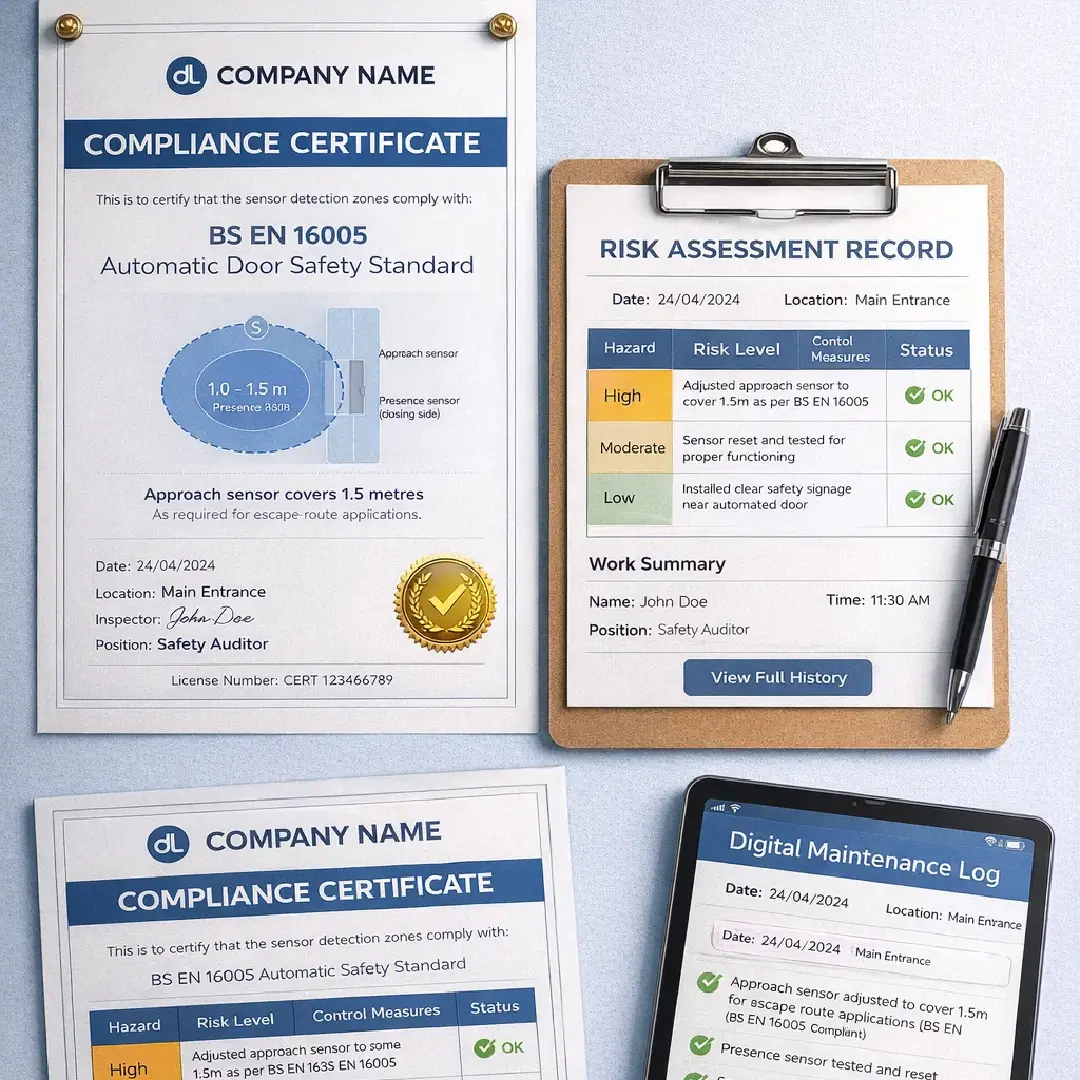
You should receive a BS EN 16005 compliance certificate, an updated risk assessment record, a maintenance log entry for the visit, and a scheduled reminder for the next inspection. Retain all documentation securely — it may be requested by insurers, HSE inspectors, or courts.
Can I check compliance myself without an engineer?
Building managers can and should carry out regular visual checks and log them. However, a formal compliance inspection — including calibrated force testing and documented sensor checks — must be carried out by a competent, trained engineer. This is the only way to produce a valid compliance certificate.
Next Doors Ltd carries out full BS EN 16005 compliance audits for commercial buildings across the UK. Our certified engineers test, certify, and document everything in a single visit — so you leave with complete peace of mind and full legal cover.
No obligation · Typically completed in under an hour on-site · Certificate issued same day
