
What is BS EN 16005 and is my automatic door compliant?
Next Doors Ltd · 5–6 min read · Commercial buildings · Updated April 2026
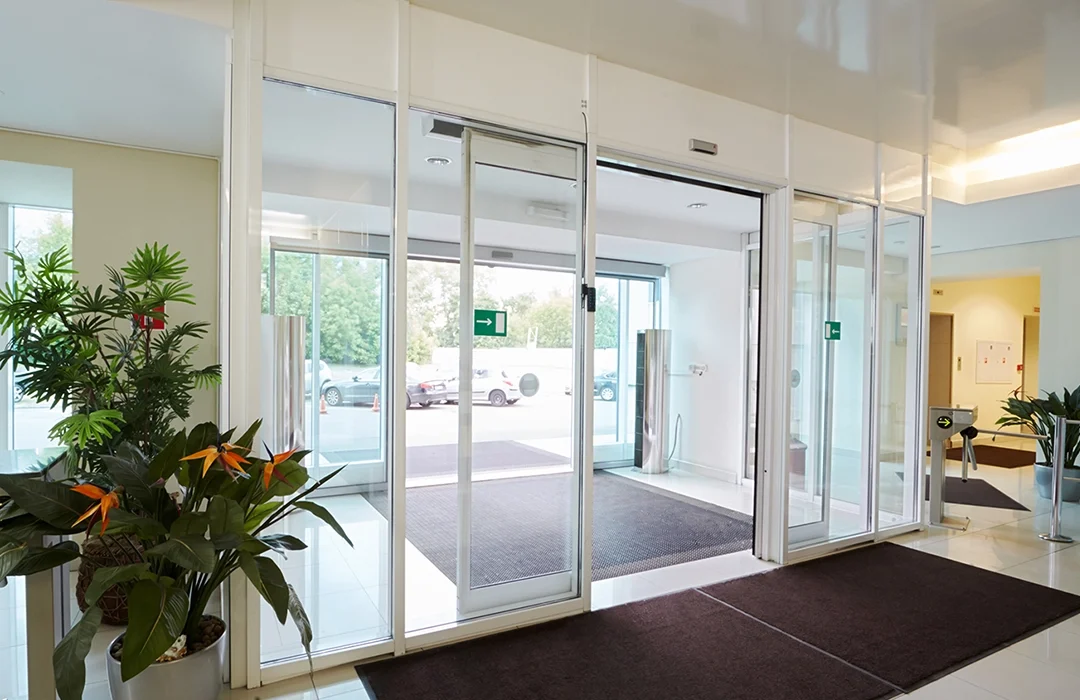
BS EN 16005 is the UK’s recognised safety standard for power-operated pedestrian doors — covering automatic sliding, swing, folding, and revolving doors installed in commercial and public buildings. It sets out the rules for design, installation, operation, and ongoing maintenance to keep everyone who passes through your entrance safe. While the standard itself is not a piece of legislation, it is the industry-accepted route to legal compliance under the Supply of Machinery (Safety) Regulations 2008 and the Provision and Use of Work Equipment Regulations 1998 (PUWER). In plain terms: the law says your doors must be safe; BS EN 16005 is how you prove they are.
Not sure if your doors are compliant? Our engineers carry out full BS EN 16005 compliance audits across commercial properties. Fast, documented, and fully certified — typically completed within an hour on-site.
What does BS EN 16005 actually cover?
The standard was first introduced in April 2013, replacing the older BS 7036:1996 series, and was most recently updated in 2023 as BS EN 16005:2023. It applies to all new automatic door installations and to any existing door that undergoes significant modification or maintenance work. If your automatic doors were fitted before April 2013 and have not been substantially altered since, they may be assessed against the older standard — but you are still expected to bring them in line with current requirements wherever it is reasonably practicable.
BS EN 16005 is built around 11 main clauses and 18 annexes. It covers everything from the specific hazards a powered door can create — crushing, impact, shearing, drawing-in — through to detailed force-testing methods, required documentation, signage requirements, and the ongoing duties of building owners and operators. The standard is accompanied by BS 7036-0:2014, a code of practice on risk assessment and risk reduction that should be read alongside it.
- Maximum impact force: 67 Newtons
- Escape route detection: 1.5 metres
- Safety barrier height: minimum 900mm
- Sensor detection zone: minimum 1 metre
- Minimum inspection frequency: 1 per year
- Glass door markings: at 850mm and 1500mm
Is BS EN 16005 a legal requirement?
Strictly speaking, BS EN 16005 is not an Act of Parliament — you cannot be prosecuted solely for failing to follow it. However, the legal picture is more complex than that simple answer implies, and ignoring the standard carries very real risk for building owners and facilities managers.
For new installations, the Supply of Machinery (Safety) Regulations 2008 are the governing legislation. Compliance with BS EN 16005 gives you a “presumption of conformity” with those regulations — meaning it is the accepted, recognised route to proving your door meets its legal requirements. For existing doors already in operation, PUWER 1998 places a duty on anyone who owns, operates, or controls work equipment to ensure it is safe, properly maintained, and fit for purpose. Courts and insurers routinely reference BS EN 16005 as the benchmark when assessing whether that duty has been satisfied.
- WHAT HAPPENS IF YOU ARE NON-COMPLIANT?
Non-compliance can result in fines of up to £10,000, prosecution under the Health and Safety at Work Act 1974, invalidated insurance policies, and personal civil liability in the event of an accident or injury. In serious cases, individuals responsible for a building can face imprisonment. Claims arising from a non-compliant automatic door may be rejected by your insurer, leaving you personally liable for any damages awarded.
67N
Maximum permissible impact force on a closing door leaf
£10k
Maximum fine for non-compliance under the Fire Safety Order
1 P/Y
Minimum mandatory inspection frequency for all powered doors
Unsure about your legal obligations?
Our team can advise you on exactly where you stand — quickly and without jargon. We work with commercial property managers across the UK.
What are the key requirements of BS EN 16005?
The standard covers every stage of an automatic door’s life — from specification and installation through to day-to-day operation and annual servicing. Below are the core requirements every building owner or facilities manager should understand.

Automatic Sliding Door

Automatic Swing Door
Safety sensors and detection zones
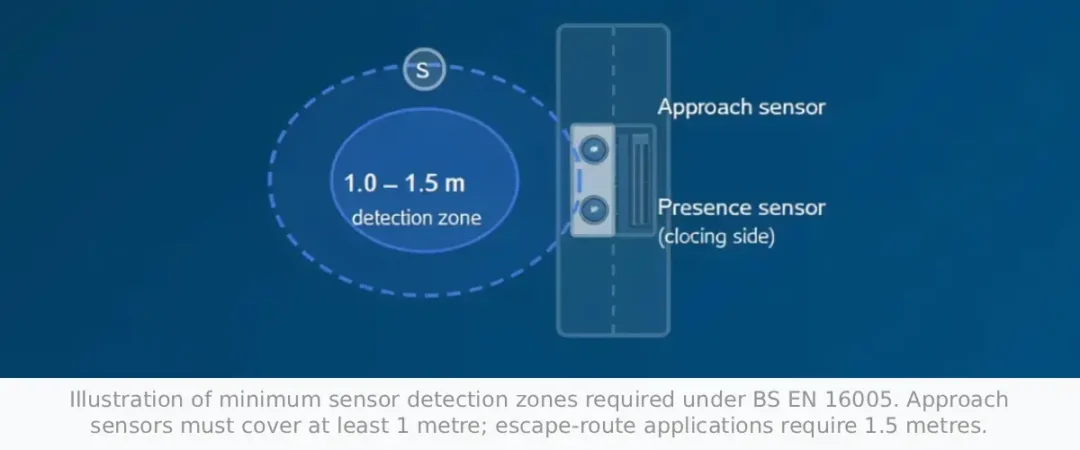
Every automatic door must be fitted with sensors that detect people or objects both approaching and standing in the door’s path. The minimum detection zone on the approach side is one metre, extending to 1.5 metres where the door serves an escape route. Sensors must be tested and verified as part of any compliance inspection, and any detection gaps must be addressed through additional sensor coverage or guarding.
Force limitation
If a door leaf comes into contact with a person, the force of that impact must not exceed 67 Newtons. The broader BS EN 12453 standard sets further limits: a maximum crushing force of 400N and a maximum impact force of 1,400N, with forces required to reduce to 150N within 0.75 seconds and to 25N within five seconds of contact. Force testing using a calibrated meter must be carried out and documented at every compliance inspection.
Emergency escape and fail-safe behaviour
Automatic doors on escape routes must be designed to open — or remain manually openable — in the event of a power failure. Fire-rated automatic doors must close automatically upon fire alarm activation, fail-safe open within five seconds of power loss, and be integrated with the building’s fire alarm system. Break-out functionality — the ability to push a door leaf open manually under force — is required on escape routes.
Signage and visual markings
Clear signage indicating the presence of automatic doors and the direction they open is mandatory. For fully glazed doors, visual contrast markings must be applied at heights of 850 mm and 1,500 mm from the floor. This requirement simultaneously supports compliance with the Equality Act 2010 and DDA guidance for users who are visually impaired.
Safety barriers
Physical barriers must be installed alongside automatic doors — particularly swing doors — to guide pedestrian traffic safely away from the active sweep zone. These barriers must be at least 900 mm high, rigidly fitted at right angles to the door face, and constructed so that a 100 mm sphere cannot pass through or under them. They must extend at least 25 mm beyond the full open width of the door.
Documentation and maintenance log
BS EN 16005 requires that a log book is kept for every automatic door, recording all inspections, tests, and maintenance visits. This is not optional — inspectors, insurers, and courts can and do request this documentation. If you cannot produce a maintenance log, your ability to demonstrate compliance is severely compromised.
How do I know if my automatic doors are compliant?
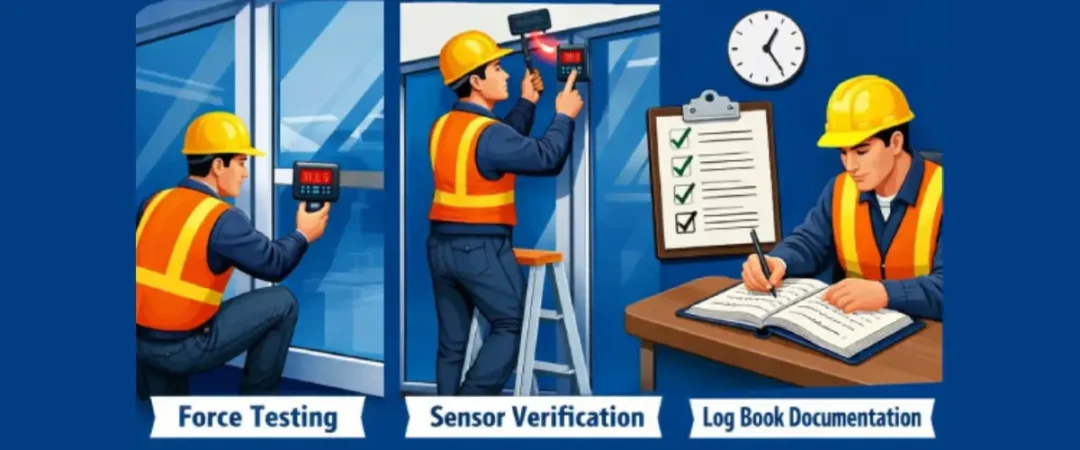
The most reliable way to establish compliance is a professional audit carried out by a competent, trained engineer. This typically involves a sensor walk test, force and speed measurements using a calibrated meter, an emergency release check, a review of signage and visual markings, and a thorough inspection of your maintenance log. The engineer will document all findings and issue a compliance certificate along with a prioritised action plan for any remedial work required.
Outside of a formal audit, the checklist below gives a useful starting point for building managers assessing their own doors.
- Approach and presence sensors are functioning and cover the required detection zones. Minimum 1 m on the approach side; 1.5 m on escape routes.
- Door opening and closing forces have been tested and recorded with a calibrated force gauge. Maximum impact force of 67 Newtons.
- Emergency release and fail-safe operation has been tested. Escape-route doors must open or remain openable within 5 seconds of power loss.
- Compliant signage is clearly visible and accurate. Glazed doors must carry contrast markings at 850 mm and 1,500 mm.
- Safety barriers are installed and meet the 900 mm minimum height requirement.
- A maintenance log book is in place, up to date, and readily available. All inspections and maintenance visits must be recorded — inspectors may request this.
- A professional compliance inspection has been completed within the last 12 months
What happens during a BS EN 16005 compliance inspection?
A compliance inspection by a qualified engineer typically takes around 45 minutes per set of doors and covers the following: a site assessment reviewing door locations, traffic flow, and the likely range of users (including children, wheelchair users, and people with pushchairs or trolleys); testing of all sensors and activation devices; measurement of door speeds and closing forces; verification of emergency break-out and fail-safe features; confirmation of signage accuracy and positioning; and a full log of findings for your records.
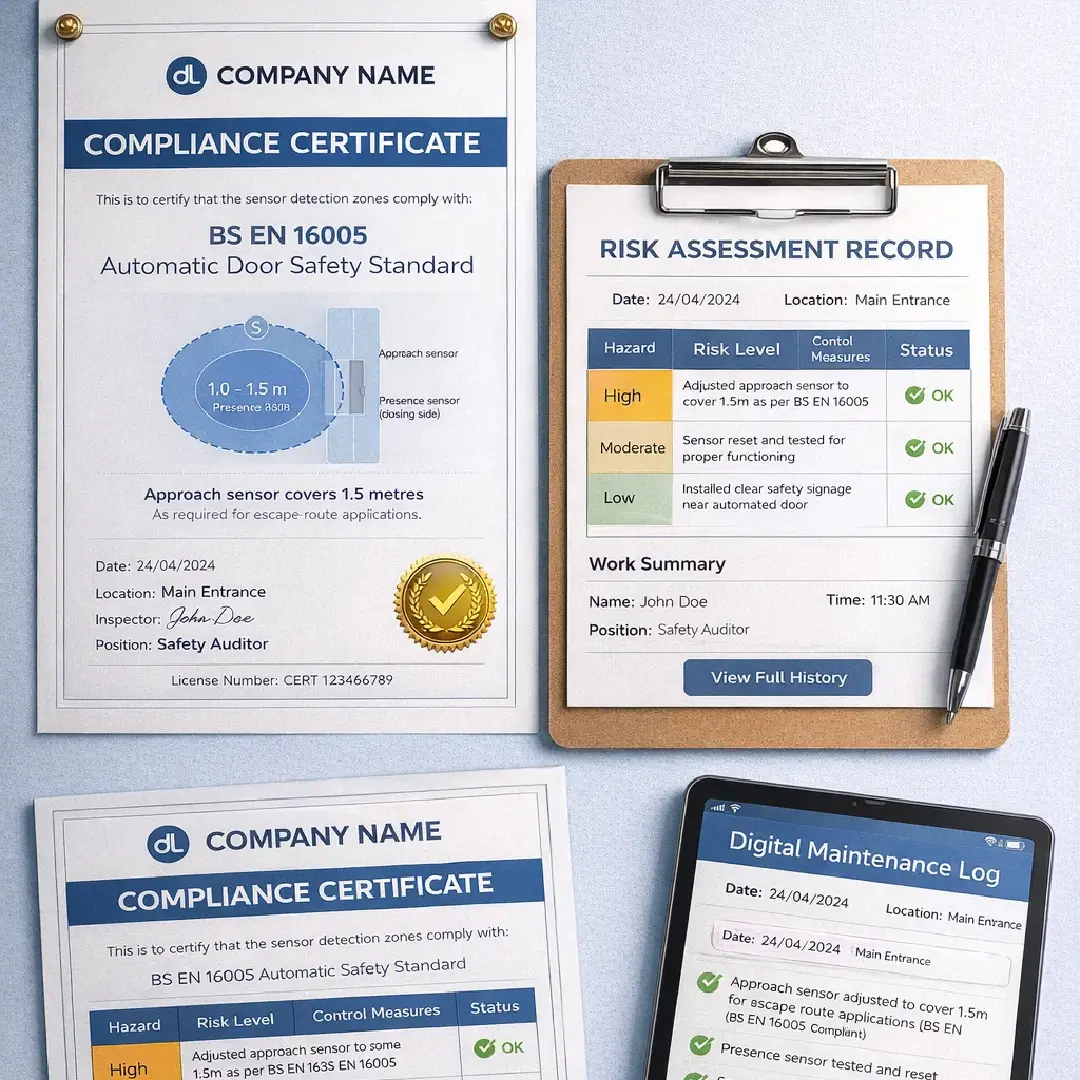
You should leave the inspection with a compliance certificate, an updated risk assessment, a digital maintenance log entry, and a schedule for the next inspection. Where issues are identified, a competent engineer should provide clear recommendations with a prioritised timeline — not just a list of problems.
Book your BS EN 16005 inspection today
Our certified engineers cover commercial properties across the UK. We provide a full compliance certificate, risk assessment, and maintenance log on the same visit.
How often do automatic doors need to be inspected?
BS EN 16005 requires at least one annual inspection by a competent person, and this is reinforced by PUWER 1998. High-traffic locations — hospitals, retail centres, schools, and transport hubs — may require biannual or quarterly checks, depending on the outcome of a documented risk assessment. A formal inspection should also be triggered after any incident involving the door, following significant repairs or modifications, or after any change in the building’s use or layout that might affect pedestrian flow.
In addition to formal inspections, BS EN 16005 places a responsibility on building managers and owners to carry out regular visual checks — looking for obvious hazards such as sensor misalignment, obstructions in the sweep zone, damaged finger guards, worn drive mechanisms, or signage that has been removed or obscured. These day-to-day checks should be recorded in the maintenance log.
What about doors installed before 2013?
Doors fitted before April 2013 may have originally complied with the older BS 7036:1996 standard. Provided those doors have not been significantly modified since, they can still be assessed against the earlier standard. However, best practice — and the expectation of courts and insurers — is that older installations are brought into alignment with BS EN 16005 wherever it is reasonably practicable to do so.
In practice this often means upgrading the sensor package, reprogramming the door operator for reduced speed and closing force, and adding compliant finger guards and signage. Where an older operator cannot be economically upgraded to meet the required safety thresholds, full replacement may be the most cost-effective and safest route — and removes the liability risk of running a system that cannot achieve modern force and detection standards.
Frequently asked questions about BS EN 16005
Is BS EN 16005 the same as BS 7036?
No. BS EN 16005 replaced BS 7036:1996 from April 2013 and was updated most recently in 2023. BS 7036-0:2014 remains a useful companion code of practice covering risk assessment methodology, and BS EN 16005:2023 specifically recommends it be read alongside the main standard.
Who is responsible for ensuring compliance with BS EN 16005?
Under PUWER 1998, the duty falls on anyone who owns, operates, or controls work equipment — which includes automatic pedestrian doors. In a commercial building this is typically the building owner, the occupier, or the facilities management team, depending on the terms of the lease or management agreement.
Does BS EN 16005 apply to residential properties?
The standard primarily targets commercial and public buildings. For powered doors in residential settings — such as communal entrance doors to apartment blocks or automated gates — similar safety principles apply, but the specific regulatory obligations differ. If in doubt, a risk assessment by a competent engineer is the appropriate starting point.
How long does a BS EN 16005 compliance inspection take?
A pair of trained engineers can typically inspect, force-test, and fully document a standard set of automatic sliding or swing doors in approximately 45 minutes, including all paperwork and the compliance certificate.
What documents should I receive after a compliance inspection?
You should receive a BS EN 16005 compliance certificate, an updated risk assessment record, a maintenance log entry for the visit, and a scheduled reminder for the next inspection. Retain all documentation securely — it may be requested by insurers, HSE inspectors, or courts.
Can I check compliance myself without an engineer?
Building managers can and should carry out regular visual checks and log them. However, a formal compliance inspection — including calibrated force testing and documented sensor checks — must be carried out by a competent, trained engineer. This is the only way to produce a valid compliance certificate.
Next Doors Ltd carries out full BS EN 16005 compliance audits for commercial buildings across the UK. Our certified engineers test, certify, and document everything in a single visit — so you leave with complete peace of mind and full legal cover.
No obligation · Typically completed in under an hour on-site · Certificate issued same day
